What Are Quantum Computers? The Future of Computation Unveiled
quantum computers

What Are Quantum Computers? The Future of Computation Unveiled

Unlock the secrets of the next generation of computing and understand their profound impact on science, medicine, and AI.

Explore Quantum Computing

Key Takeaways

  • ✓ Quantum computers utilize principles of quantum mechanics like superposition and entanglement.
  • ✓ Unlike classical bits, quantum bits (qubits) can represent 0, 1, or both simultaneously.
  • ✓ They excel at solving certain complex problems intractable for even the most powerful classical supercomputers.
  • ✓ Major applications include drug discovery, materials science, financial modeling, and artificial intelligence.

How It Works

1
Qubits: The Quantum Foundation

Instead of classical bits (0 or 1), quantum computers use qubits. Qubits can exist in a superposition, representing 0, 1, or a combination of both simultaneously, dramatically increasing information density.

2
Superposition: Multiple States at Once

This principle allows a qubit to be in multiple states at the same time. This means a quantum computer can process many possibilities concurrently, unlike classical computers that must process them sequentially.

3
Entanglement: Interconnected Qubits

Entangled qubits become intrinsically linked, meaning the state of one instantly influences the state of another, regardless of distance. This powerful correlation allows for complex computations and parallel processing.

4
Quantum Gates & Algorithms

Quantum information is manipulated using quantum gates, analogous to logic gates in classical computing. Specific quantum algorithms leverage superposition and entanglement to solve problems exponentially faster.

Understanding the Fundamentals of Quantum Computing
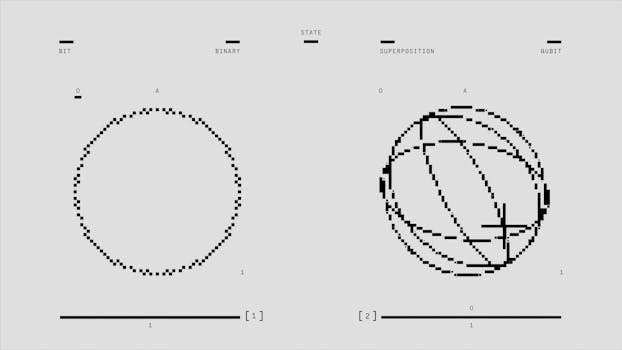
Illustration depicting classical binary bit and quantum qubit states in superposition and binary. Photo: Google DeepMind / Pexels
To truly grasp what are quantum computers, we must first dive into the mind-bending world of quantum mechanics, the branch of physics that governs the behavior of matter and energy at the atomic and subatomic levels. Unlike the deterministic and predictable world we experience daily, the quantum realm is characterized by probabilities, uncertainties, and phenomena that defy classical intuition. At the heart of quantum computing lies the 'qubit,' or quantum bit, which serves as the fundamental unit of information. While a classical bit can only exist in one of two states—either 0 or 1—a qubit leverages two peculiar quantum phenomena: superposition and entanglement. Superposition allows a qubit to exist in a combination of both 0 and 1 simultaneously. Imagine a coin spinning in the air; until it lands, it's neither heads nor tails but a blend of both possibilities. This ability to be in multiple states at once means that a single qubit can store far more information than a classical bit. As the number of qubits increases, the computational power grows exponentially, not linearly. For instance, two qubits in superposition can represent four states simultaneously (00, 01, 10, 11), three qubits can represent eight states, and so on. This exponential scaling is what gives quantum computers their immense potential. The second crucial concept is entanglement. When two or more qubits become entangled, they become intrinsically linked, sharing a common fate regardless of the physical distance separating them. If you measure the state of one entangled qubit, you instantly know the state of its entangled partner, even if they are light-years apart. This 'spooky action at a distance,' as Albert Einstein famously called it, is not only real but is a powerful resource for quantum computation. Entanglement allows quantum computers to perform operations on multiple qubits simultaneously, enabling complex correlations and parallel processing that are impossible for classical machines. These quantum phenomena are not merely theoretical curiosities; they are the bedrock upon which quantum algorithms are built, allowing these new machines to tackle problems that are currently intractable for even the most powerful supercomputers. Understanding these basic principles is the first step in appreciating the revolutionary potential of quantum computers and their role in shaping our technological future. The journey from classical to quantum is a fundamental shift in how we process information, opening doors to previously unimaginable computational capabilities. Learn more about the history of computing to appreciate this leap.

How Quantum Computers Work: Beyond Bits and Bytes
Detailed close-up of a circuit board showcasing electronic components in soft focus. Photo: Pok Rie / Pexels
The operational mechanics of what are quantum computers differ fundamentally from classical computers. Instead of silicon-based microchips and electrical impulses, quantum computers often rely on highly specialized hardware designed to maintain and manipulate qubits in extremely delicate environments. Many quantum computers operate at temperatures colder than deep space, just a fraction of a degree above absolute zero, to minimize quantum decoherence—the loss of quantum properties due to interaction with the environment. Various physical systems can serve as qubits, each with its own advantages and challenges. Superconducting circuits, trapped ions, photonic systems, and topological qubits are among the leading candidates. Superconducting qubits, for example, are tiny loops of superconducting material that can support quantum states. Trapped ion quantum computers use lasers to hold and manipulate individual charged atoms, where the electronic states of the ions represent the qubits. Photonic quantum computers use photons (particles of light) as qubits, encoding information in their polarization or phase. Regardless of the underlying physical implementation, the core operations involve preparing qubits in specific initial states, applying quantum gates to manipulate their states, and finally measuring the results. Quantum gates are the building blocks of quantum algorithms, analogous to logic gates (AND, OR, NOT) in classical computing. However, quantum gates can perform operations that have no classical counterpart, such as creating superposition or entanglement. These gates are typically implemented using precisely controlled external fields, such as microwaves, lasers, or magnetic fields, depending on the qubit technology. The real power of quantum computers emerges when these gates are combined into quantum algorithms. Algorithms like Shor's algorithm, which can factor large numbers exponentially faster than classical algorithms, or Grover's algorithm, which can search unsorted databases quadratically faster, demonstrate the potential for quantum speedup. These algorithms cleverly exploit superposition and entanglement to explore multiple computational paths simultaneously, vastly accelerating problem-solving for specific types of tasks. The final step in quantum computation is measurement. When a qubit in superposition is measured, it 'collapses' into a definite classical state (either 0 or 1). Because quantum operations are probabilistic, executing a quantum algorithm often requires repeating the computation multiple times and statistically analyzing the measurement outcomes to infer the correct solution. This unique process of leveraging quantum phenomena for computation represents a paradigm shift, moving beyond the binary logic of classical machines into a realm where possibilities are explored concurrently.

Transformative Applications and Future Impact of Quantum Computing
Abstract representation of a futuristic digital processor with glowing elements. Photo: Pachon in Motion / Pexels
The implications of what are quantum computers extend far beyond academic curiosity, promising to revolutionize numerous industries and scientific fields. While still in their nascent stages, the potential applications of quantum computing are vast and truly transformative. One of the most anticipated impacts is in the field of drug discovery and materials science. Designing new drugs or materials often involves simulating molecular interactions at a quantum level, a task that quickly overwhelms classical computers due to the exponential complexity. Quantum computers, with their ability to handle quantum mechanical calculations directly, could accurately model complex molecules, accelerate the discovery of new medicines, and engineer novel materials with unprecedented properties, such as superconductors or highly efficient catalysts. In finance, quantum algorithms could optimize complex portfolios, detect fraud with greater accuracy, and develop more sophisticated financial models for predicting market behavior. The ability to process vast amounts of data and explore numerous possibilities simultaneously would provide a significant edge in high-frequency trading and risk assessment. Another major area of impact is artificial intelligence and machine learning. Quantum machine learning algorithms could process larger datasets, identify more intricate patterns, and potentially lead to breakthroughs in areas like image recognition, natural language processing, and advanced AI systems that can learn and adapt more effectively. Quantum neural networks, for example, could offer new ways to train and optimize complex AI models. Cybersecurity is another critical domain. While Shor's algorithm poses a threat to current encryption standards (like RSA), the development of quantum-resistant cryptography (post-quantum cryptography) is actively underway. Ironically, quantum computers could also be instrumental in designing and breaking new, more secure encryption methods, creating a continuous arms race in the digital security landscape. Furthermore, quantum computers hold immense promise for solving complex optimization problems across various sectors, from logistics and supply chain management to traffic flow optimization and airline scheduling. Businesses could achieve unprecedented efficiencies by finding optimal solutions to problems with an astronomical number of variables. The journey to widespread quantum computing is still long, facing challenges in scalability, error correction, and maintaining quantum coherence. However, the rapid pace of research and development, coupled with significant investments from governments and tech giants, suggests that quantum computers will eventually transition from specialized research tools to powerful engines driving the next wave of technological innovation. Embracing this future requires understanding not just the technology, but also its ethical implications and societal benefits. Explore the ethical considerations of emerging technologies to understand the broader context.

Challenges and Misconceptions About Quantum Computing
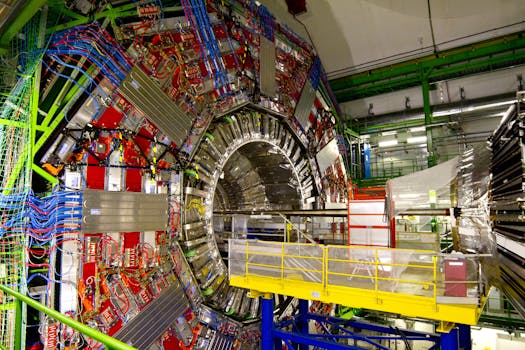
A close-up view inside CERN's Large Hadron Collider in Geneva, Switzerland. Photo: Ramaz Bluashvili / Pexels
Despite the immense promise of what are quantum computers, it's crucial to address the significant challenges and common misconceptions surrounding this emerging technology. One of the primary hurdles is the issue of quantum decoherence. Qubits are incredibly fragile and easily lose their quantum properties when they interact with their environment, even slightly. This makes maintaining their quantum state for long enough to perform complex calculations exceedingly difficult. Researchers employ various techniques, such as operating at extremely low temperatures or in vacuum environments, but it remains a major engineering challenge. Error correction is another monumental task. Unlike classical bits, where errors can be easily detected and corrected, quantum errors are more complex and can propagate quickly. Developing robust quantum error correction codes is essential for building fault-tolerant quantum computers that can perform reliable computations. This often requires a significant overhead, meaning many physical qubits are needed to create a single 'logical' qubit that is protected from errors. Scalability is also a significant challenge. Building quantum computers with a large number of high-quality, interconnected qubits is incredibly difficult. While laboratories have demonstrated systems with tens or even a hundred-plus qubits, reaching the millions of qubits needed for truly transformative applications is still a distant goal. Furthermore, the programming and algorithm development for quantum computers are vastly different from classical computing. There's a steep learning curve for developers, and specialized quantum algorithms are required to harness their unique capabilities. It's not simply a matter of running existing software faster. A common misconception is that quantum computers will replace all classical computers. This is highly unlikely. Quantum computers are not general-purpose machines; they are accelerators designed to solve specific, highly complex problems that classical computers struggle with. They will likely work in tandem with classical systems, acting as powerful co-processors for particular tasks. Another misconception is that quantum computers will make all current encryption obsolete overnight. While they pose a significant threat to certain public-key cryptographic systems, the transition to quantum-resistant cryptography is already underway, and widespread disruption isn't immediate. Finally, there's the idea that quantum computers are just faster classical computers. This is incorrect. They operate on entirely different principles, solving problems in fundamentally different ways, often by exploring multiple possibilities simultaneously rather than simply processing data at a higher clock speed. Overcoming these challenges requires continued innovation, significant investment, and a deeper understanding of quantum physics and engineering. However, the rewards for doing so are immense, promising a new era of computational power.

Comparison

FeatureQuantum ComputersClassical ComputersSupercomputers
Fundamental UnitQubit (0, 1, or both)Bit (0 or 1)Bit (0 or 1)
Information ProcessingSuperposition, EntanglementBinary logic gatesBinary logic gates
Computational PowerExponential scaling for specific problemsLinear scalingMassive parallel classical processing
Problem SuitabilityOptimization, simulation, AI, cryptographyGeneral-purpose tasks, everyday computingComplex classical simulations, big data
Current StateEarly stage, noisy intermediate-scale quantum (NISQ)Mature, ubiquitousHighly developed, specialized

What Readers Say

"This article brilliantly explains what are quantum computers without oversimplifying the complex physics. It's an essential read for anyone trying to grasp the next frontier of computation."

Dr. Anya Sharma · Boston, MA

"As a software engineer, I found this breakdown of quantum computing incredibly insightful. The distinction between classical and quantum operations is very clearly articulated, helping me understand the architectural shift."

Mark Jenkins · San Francisco, CA

"The depth of explanation on superposition and entanglement finally made sense to me. This article has significantly improved my understanding of quantum mechanics' application in computing, leading to new research ideas."

Prof. David Lee · Austin, TX

"Very comprehensive! While some parts were still a bit challenging for a layperson, the overall clarity and structure made it a valuable resource. I appreciate the discussion on future applications."

Sarah Chen · New York, NY

"This is the clearest explanation of what are quantum computers I've found online. It balances technical detail with accessibility, making a complex topic approachable for anyone curious about the future of tech."

Michael Ramirez · Seattle, WA

Frequently Asked Questions

What is the main difference between a classical computer and a quantum computer?

The core difference lies in their fundamental units and how they process information. Classical computers use bits that are either 0 or 1. Quantum computers use qubits, which can be 0, 1, or both simultaneously through superposition, and can also be entangled, allowing for exponentially more complex calculations and parallel processing on specific problems.

Are quantum computers available for public use today?

While fully fault-tolerant, universal quantum computers are still in development, many companies and research institutions offer cloud-based access to their quantum processors. This allows researchers and developers to experiment with quantum algorithms and explore their potential without needing their own hardware.

How do you program a quantum computer?

Programming a quantum computer involves using specialized quantum programming languages (like Qiskit, Cirq, or OpenQASM) to construct quantum circuits. These circuits define a sequence of quantum gates that manipulate qubits to perform the desired computation, leveraging quantum phenomena like superposition and entanglement.

How much do quantum computers cost?

Quantum computers are incredibly expensive to research, develop, and build, with costs ranging from millions to hundreds of millions of dollars for a single machine. They are not commercially available for purchase by individuals or most businesses, but access is typically provided through cloud services on a pay-per-use or subscription model.

Will quantum computers make classical computers obsolete?

No, quantum computers are unlikely to make classical computers obsolete. They are specialized tools designed to excel at specific, highly complex computational problems that are intractable for classical machines. Classical computers will continue to be essential for everyday tasks, general-purpose computing, and managing the quantum systems themselves.

Who should learn about quantum computers?

Anyone involved in advanced scientific research, drug discovery, materials science, financial modeling, artificial intelligence, cybersecurity, or complex optimization problems should learn about quantum computers. It's also vital for policymakers, investors, and technologists who want to understand the next wave of technological disruption.

Are there any risks associated with quantum computing?

Yes, there are risks, primarily in cybersecurity. Quantum computers could potentially break current public-key encryption methods, necessitating the development and adoption of new 'quantum-safe' cryptographic standards. There are also ethical considerations regarding their immense power and potential for misuse.

What is the future outlook for quantum computing?

The future outlook for quantum computing is optimistic but also recognizes the significant challenges ahead. Experts predict that within the next decade, we will see 'quantum advantage' in specific, useful applications, moving beyond current 'noisy intermediate-scale quantum' (NISQ) devices towards more robust, error-corrected quantum computers that can deliver real-world impact across many industries.

Understanding what are quantum computers is no longer just for physicists; it's crucial for anyone looking to the future of technology. Delve deeper into this revolutionary field and prepare for the profound changes they are set to bring to our world.

Topics: quantum computersquantum computing explainedquantum mechanicsqubitsfuture of technology
Leo List

DK Escorts LU Escorts AT Escorts SE Escorts FI Escorts CH Escorts DE Escorts HR Escorts IE Escorts GR Escorts CZ Escorts NO Escorts BE Escorts FR Escorts SI Escorts IL Escorts NL Escorts PL Escorts HU Escorts ES Escorts IT Escorts PT Escorts SK Escorts RO Escorts ZA Escorts UY Escorts US Escorts UK Escorts NZ Escorts AU Escorts
Brampton weed
Adultwork EstrelaBet Vai de Bet R7 Bet Betão Galera Bet Rainbet Bet9ja Shop SportyBet BetKing Sisal Loto Foot Hollywoodbets YesPlay Odibets RushBet Jugabet BetWarrior BetCity MSport betPawa Fortebet