
Unlocking the future of quantum computing's potential
future of quantum computing

Unlocking the future of quantum computing's potential

Dive into the next era of computation and discover how quantum will reshape industries and solve humanity's greatest challenges.

Explore Quantum's Future

Key Takeaways

  • ✓ Quantum computers harness quantum-mechanical phenomena like superposition and entanglement.
  • ✓ They are not just faster, but fundamentally different from classical computers.
  • ✓ Potential applications span drug discovery, materials science, finance, and AI.
  • ✓ Significant engineering and algorithmic challenges remain before widespread adoption.

How It Works

1
Quantum Bit (Qubit) Foundation

Unlike classical bits (0 or 1), qubits can exist in a superposition of both states simultaneously. This allows quantum computers to process exponentially more information than classical computers.

2
Leveraging Superposition and Entanglement

Superposition allows qubits to represent multiple possibilities at once. Entanglement links qubits so their states are dependent on each other, regardless of distance, enabling complex computations.

3
Quantum Gates and Circuits

Quantum gates manipulate qubits in a similar way classical logic gates manipulate bits. These gates form quantum circuits, which are sequences of operations designed to solve specific problems.

4
Measurement and Output

After computation, the quantum state collapses upon measurement, yielding a classical outcome (0 or 1). Running the computation multiple times helps extract the probabilistic correct answer.

The Unprecedented Power of Quantum Technology
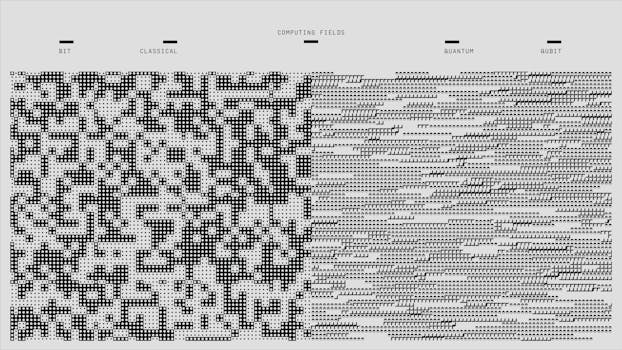
Abstract design showcasing computing fields with geometric and binary patterns in black and white. Photo: Google DeepMind / Pexels
The future of quantum computing promises a paradigm shift in computational power, moving beyond the limits of classical physics. Unlike traditional computers that rely on bits representing either 0 or 1, quantum computers leverage the bizarre yet powerful principles of quantum mechanics, specifically superposition and entanglement. Superposition allows a quantum bit, or 'qubit,' to exist in multiple states simultaneously, meaning it can be 0, 1, or both at the same time. This exponential increase in information storage and processing capability is what gives quantum computing its theoretical edge. Imagine a library where every book can be in every possible state (open, closed, on any page) at once; a classical computer would have to check each state sequentially, while a quantum computer could explore all states in parallel. Entanglement, another cornerstone of quantum mechanics, describes a phenomenon where two or more qubits become inextricably linked, regardless of the physical distance separating them. The state of one entangled qubit instantaneously influences the state of the others. This 'spooky action at a distance,' as Einstein famously called it, allows quantum computers to perform computations that are intractable for even the most powerful supercomputers. These intertwined phenomena enable quantum algorithms, such as Shor's algorithm for factoring large numbers or Grover's algorithm for searching unsorted databases, to achieve speedups that are polynomial or even exponential compared to their classical counterparts. This isn't just about faster calculations; it's about solving problems that are currently impossible. For instance, simulating complex molecular interactions for drug discovery or materials science requires an understanding of quantum mechanics itself, a task classical computers struggle with due to the sheer number of variables. Quantum computers, by their very nature, are designed to handle such complexities. While still in its nascent stages, the theoretical underpinnings and early experimental results strongly suggest that the impact of quantum technology will be profound, fundamentally altering how we approach scientific research, engineering, and data analysis. The journey from theoretical concept to practical application is fraught with challenges, but the potential rewards are immense, driving intense research and development globally. The implications for national security, economic competitiveness, and scientific advancement are so significant that governments and major corporations are investing heavily in this transformative field.

Transformative Applications Across Industries
Abstract representation of a futuristic digital processor with glowing elements. Photo: Pachon in Motion / Pexels
The future of quantum computing isn't confined to academic laboratories; its eventual applications are set to revolutionize a multitude of industries, from healthcare and finance to logistics and artificial intelligence. In drug discovery, quantum computers could accurately simulate molecular structures and interactions, leading to the development of new, more effective medications and personalized treatments much faster than current methods. Imagine designing a new drug in weeks rather than years, precisely targeting diseases with minimal side effects. Similarly, in materials science, quantum simulations could unlock the creation of novel materials with bespoke properties – think of superconductors that work at room temperature, super-efficient catalysts, or lighter, stronger alloys for aerospace. These advancements would have a cascading effect across manufacturing and energy sectors. Financial services stand to benefit immensely from quantum computing's ability to handle complex optimization problems. Quantum algorithms could enhance portfolio optimization, fraud detection, and risk analysis with unprecedented speed and accuracy. Predicting market fluctuations and managing complex financial derivatives could become significantly more sophisticated, leading to more stable and profitable economic systems. In logistics and supply chain management, quantum optimization could solve the 'traveling salesman problem' for vastly more variables, finding the most efficient routes and resource allocations for global networks, reducing costs and environmental impact. For artificial intelligence, quantum machine learning algorithms could process enormous datasets, identify intricate patterns, and train AI models with a level of complexity and speed currently unimaginable. This could lead to breakthroughs in areas like image recognition, natural language processing, and autonomous systems, propelling AI capabilities far beyond current benchmarks. Even cybersecurity, while facing new threats from quantum decryption, will also benefit from quantum-resistant cryptographic solutions developed with quantum principles. The sheer scope of these potential applications underscores why the development of quantum computing is a global race, promising to reshape the technological landscape and redefine the boundaries of what's computationally possible.

Navigating the Quantum Computing Timeline and Challenges
Retro Quantum ProDrive hard disk drive on a light background, showcasing vintage computer technology. Photo: Nicolas Foster / Pexels
While the promise of the future of quantum computing is undeniable, its widespread realization is still some years, if not decades, away. The journey involves overcoming significant scientific and engineering hurdles. One of the primary challenges is achieving quantum supremacy, where a quantum computer can perform a task provably beyond the capabilities of any classical computer, which has been demonstrated for specific, highly constrained problems. However, moving from this demonstration to practical, error-corrected quantum computers capable of solving real-world problems is a monumental task. Qubits are incredibly fragile; they are highly susceptible to decoherence, where interactions with their environment cause them to lose their quantum properties. Maintaining their delicate quantum states requires extreme isolation, often at temperatures colder than deep space, which presents immense engineering difficulties. Building fault-tolerant quantum computers with a sufficient number of stable, high-fidelity qubits is another major hurdle. Current quantum machines have dozens or hundreds of noisy qubits, meaning they are prone to errors. Developing robust error-correction techniques that can detect and fix these errors without introducing new ones is crucial for scaling quantum computers to thousands or millions of logical qubits needed for complex applications. This requires a deeper understanding of quantum algorithms and the development of new programming paradigms specifically tailored for quantum architectures. Furthermore, the infrastructure required to build and maintain these machines is incredibly complex and expensive. The timeline for achieving these milestones is often debated among experts. Some predict that useful 'noisy intermediate-scale quantum' (NISQ) devices will find specialized applications within the next 5-10 years, particularly in areas like quantum chemistry or materials simulation where some noise can be tolerated. However, truly fault-tolerant, universal quantum computers capable of breaking current encryption or optimizing global supply chains may be 15-30 years away. The development of quantum software, compilers, and a skilled workforce capable of programming and maintaining these machines also lags behind hardware advancements. Despite these challenges, the pace of innovation is accelerating, with significant investments from governments and tech giants alike, indicating a strong belief in the eventual realization of this revolutionary technology.

Preparing for the Quantum Era: Tips for Businesses and Individuals

Abstract view of futuristic technology inspired circuitry in vivid colors. Photo: Pachon in Motion / Pexels
As the future of quantum computing draws closer, both businesses and individuals need to start considering how to prepare for this transformative era. Ignoring quantum advancements could lead to being left behind, while proactive engagement can provide a significant competitive advantage. Here are some key tips: * **Educate and Monitor:** Stay informed about the latest developments in quantum computing. Follow leading research institutions, tech companies, and industry publications. Understand the basic principles and potential impacts relevant to your field. This isn't about becoming a quantum physicist overnight, but about grasping the strategic implications. * **Identify Potential Use Cases:** For businesses, begin to explore how quantum computing might solve your most intractable problems. Could it optimize your logistics, accelerate your R&D, or enhance your data analytics? Focus on areas where classical computing is hitting fundamental limits. Engage with quantum experts or consulting firms to conduct preliminary assessments. * **Invest in Quantum-Resistant Cryptography:** This is a critical and immediate concern. Quantum computers, once powerful enough, will be able to break many of today's standard encryption methods. Businesses handling sensitive data must begin researching and planning for the transition to post-quantum cryptography (PQC) to protect their information from future quantum attacks. This is not a future problem; it's a present need for future security. * **Start Building a Quantum-Ready Workforce:** The demand for quantum engineers, scientists, and programmers will surge. Businesses should consider supporting quantum education, sponsoring research, or even starting small internal teams to experiment with quantum algorithms on available simulators or cloud-based quantum services. Individuals interested in tech should consider learning quantum programming languages or fundamental quantum mechanics. * **Collaborate and Experiment:** Partner with universities, startups, or larger tech companies that are at the forefront of quantum research. Participating in pilot programs or early access initiatives can provide invaluable hands-on experience and insights into the practicalities and limitations of current quantum hardware and software. This collaborative approach can de-risk investment and accelerate learning. * **Develop a Long-Term Quantum Strategy:** Don't view quantum computing as a short-term trend. Integrate it into your long-term innovation and technology roadmap. This strategy should be flexible, adapting as the technology matures, but it should clearly outline how your organization plans to leverage or mitigate the effects of quantum advancements. The quantum era will not arrive as a single event, but as a gradual evolution, and preparedness will be key.

Comparison

FeatureClassical ComputersQuantum Computers (Future)
Computational ModelBits (0 or 1)Qubits (0, 1, or both simultaneously)
Processing PowerSequential, limited by transistorsParallel, exponential with qubits via superposition
Problem Types SolvedMost current problems, large data processingCurrently intractable optimization, simulation, AI problems
Energy ConsumptionSignificant, increasing with scalePotentially lower for specific complex problems
Key ChallengeMiniaturization, heat dissipationQubit stability, error correction, scalability
AvailabilityUbiquitousLimited access, mostly research/specialized tasks

What Readers Say

"The insights into the future of quantum computing are incredibly valuable. This article clearly articulates not just the 'what' but the 'why' and 'how' of this revolutionary technology, preparing us for its impact."

Dr. Evelyn Reed · Boston, MA

"As a software developer, I found the breakdown of applications across industries particularly inspiring. It's clear that understanding the future of quantum computing is no longer optional for tech professionals."

Mark Chen · San Francisco, CA

"This content helped our executive team grasp the strategic importance of quantum computing. We're now actively exploring post-quantum cryptography solutions, a direct result of this article's foresight."

Sarah Jenkins · Austin, TX

"While incredibly informative, I'd love to see more specifics on current quantum programming tools. However, the overall vision for the future of quantum computing was exceptionally well-presented and balanced."

David Miller · Seattle, WA

"From a financial analyst's perspective, the potential for portfolio optimization and risk analysis discussed here is mind-blowing. The future of quantum computing will fundamentally change how we model markets."

Elena Rodriguez · New York, NY

Frequently Asked Questions

What is the biggest difference between classical and quantum computing?

The biggest difference lies in how they process information. Classical computers use bits that are either 0 or 1. Quantum computers use qubits, which can be 0, 1, or a superposition of both simultaneously, allowing for exponentially more complex calculations and the exploration of multiple possibilities at once.

Is quantum computing a threat to current cybersecurity?

Yes, in the long term. Once sufficiently powerful, quantum computers will be able to break many of the public-key encryption methods currently used to secure data and communications. This is why research into 'post-quantum cryptography' (PQC) is a critical and active area of development to create new, quantum-resistant encryption standards.

How can businesses prepare for the quantum era?

Businesses should start by educating themselves, identifying potential use cases relevant to their industry, and, most importantly, begin planning for the transition to post-quantum cryptography to protect their data. Investing in quantum-ready talent and exploring collaborations are also crucial steps.

Will quantum computers replace classical computers?

It is highly unlikely that quantum computers will entirely replace classical computers. Instead, they are expected to complement them. Quantum computers excel at specific, highly complex problems that classical computers struggle with, while classical computers will continue to be efficient for most everyday computational tasks.

How long until quantum computers are widely available?

The timeline varies depending on the type of quantum computer. 'Noisy Intermediate-Scale Quantum' (NISQ) devices are already available via cloud platforms for research, but fault-tolerant, universal quantum computers capable of solving large-scale, practical problems are likely 15-30 years away from widespread availability.

Who should be concerned about the future of quantum computing?

Anyone involved in technology, data security, scientific research, finance, logistics, materials science, or drug discovery should be concerned. Its impact will be felt across virtually all sectors that rely on computation and data processing, making it a critical area for strategic planning.

What are the main risks associated with quantum computing development?

Beyond the cybersecurity threat, risks include the immense cost and complexity of development, the potential for a 'quantum divide' between nations with and without access to the technology, and the ethical considerations around its powerful capabilities. Managing these risks requires careful international collaboration and policy-making.

What are the next major breakthroughs expected in quantum computing?

Key breakthroughs are expected in improving qubit stability and coherence times, developing more effective error-correction techniques, scaling up the number of reliable qubits, and advancing quantum software and algorithms. These foundational improvements are necessary before widespread practical applications can emerge.

Embrace the incredible journey into the future of quantum computing. Start exploring its potential today and position yourself or your organization at the forefront of the next technological revolution.

Topics: future of quantum computingquantum technologyquantum applicationsquantum impactquantum timeline
Leo List
Brampton weed
Adultwork