
The Future of Autonomous Vehicles Technology Unveiled
Revolutionizing transportation, autonomous vehicles promise a safer, more efficient, and connected future for all.
Discover the Road AheadKey Takeaways
- ✓ Autonomous vehicles (AVs) are classified into 6 levels (0-5) based on automation, with Level 5 being fully autonomous.
- ✓ The AV market is projected to reach over $60 billion by 2030, driven by advancements in AI and sensor technology.
- ✓ Reduced traffic accidents, improved traffic flow, and increased accessibility are key benefits expected from widespread AV adoption.
- ✓ Significant challenges remain in regulation, public acceptance, cybersecurity, and infrastructure adaptation.
How It Works
AVs use a combination of cameras, radar, lidar, and ultrasonic sensors to gather real-time data about their surroundings. This multi-modal data is then merged to create a comprehensive, 360-degree environmental model.
Advanced algorithms process sensor data to identify objects (pedestrians, other vehicles, traffic signs), track their movement, and understand the vehicle's precise location on a high-definition map. This includes recognizing lane markings and road features.
Based on the perceived environment and destination, the AV's AI plans a safe and efficient path. It constantly makes decisions regarding speed, lane changes, turns, and braking, adapting to dynamic road conditions and traffic laws.
The decisions made by the AI are translated into physical commands for the vehicle's steering, acceleration, and braking systems. These systems execute the commands precisely, ensuring smooth and controlled movement without human intervention.
The Landscape of Autonomous Vehicle Technology
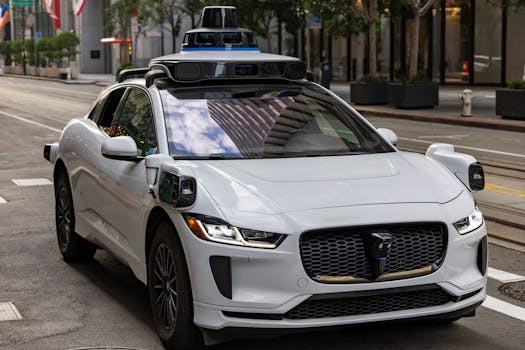 Photo: Stephen Leonardi / Pexels
Societal and Economic Impact of Self-Driving Cars
 Photo: Vlad Nazarov / Pexels
Navigating the Hurdles: Regulation, Ethics, and Public Trust
Photo: Vlad Nazarov / Pexels
Future Trends and Key Milestones in Autonomous Driving
 Photo: Abhishek Navlakha / Pexels
Comparison
| Feature | Level 5 (Full Automation) | Level 3 (Conditional Automation) | Level 2 (Partial Automation) |
|---|---|---|---|
| Human Oversight Required | ✗ (Never) | ✓ (When prompted) | ✓ (Always) |
| Driving Environment | Any road, any condition | Limited operational design domains (ODD) | Specific highway conditions |
| Driver Role | Passenger | Fallback driver | Active driver, supervising system |
| System Takes Over | All dynamic driving tasks | Most dynamic driving tasks, requests human takeover | Assists with steering/speed, human responsible |
What Readers Say
"The potential for autonomous vehicles technology to reduce commute stress is immense. I envision a future where my daily travel allows me to work or relax, which would be a huge quality-of-life improvement."
Sarah Chen · San Francisco, CA"As a logistics manager, I'm incredibly excited about autonomous trucking. It promises to drastically cut operational costs and improve delivery times, directly impacting our bottom line and supply chain efficiency."
Mark Johnson · Austin, TX"From a public health perspective, the future of autonomous vehicles technology is about saving lives. Eliminating human error in driving could reduce traffic fatalities by over 90%, a truly monumental achievement."
Dr. Emily Roberts · Boston, MA"While the technology is impressive, I still have some reservations about how autonomous vehicles will handle extreme weather, especially heavy snow. I believe more robust testing in diverse conditions is needed before full trust can be established."
David Lee · Denver, CO"For my elderly parents, autonomous vehicles represent true independence. The ability to safely get around without relying on others would transform their lives, offering dignity and freedom they currently lack."
Maria Rodriguez · Miami, FLFrequently Asked Questions
What are the biggest benefits of autonomous vehicles technology?
The primary benefits include a significant reduction in traffic accidents due to the elimination of human error, improved traffic flow and reduced congestion, increased accessibility for individuals unable to drive, and enhanced productivity during commutes. These advancements promise a safer and more efficient transportation system for everyone.
Is autonomous vehicle technology safe given current reports of accidents?
While isolated incidents receive significant media attention, autonomous vehicle technology is being developed with an unparalleled focus on safety. Testing involves billions of miles in simulation and millions in real-world scenarios. As the technology matures and regulatory frameworks strengthen, the goal is for AVs to be significantly safer than human-driven vehicles.
How will autonomous vehicles communicate with each other and infrastructure?
Autonomous vehicles will primarily use Vehicle-to-Everything (V2X) communication. This includes Vehicle-to-Vehicle (V2V) for sharing real-time data like speed and braking, and Vehicle-to-Infrastructure (V2I) for receiving information from traffic lights, road sensors, and digital signage. This connectivity is crucial for coordinated movement and safety.
What is the cost implication of widespread autonomous vehicle adoption?
Initially, autonomous vehicles will likely be more expensive due to advanced technology. However, widespread adoption could lead to lower transportation costs overall through shared autonomous fleets (robotaxis), reduced insurance premiums due to fewer accidents, and increased efficiency in logistics. The long-term value is expected to outweigh initial investment.
How do autonomous vehicles compare to advanced driver-assistance systems (ADAS)?
ADAS, such as adaptive cruise control or lane-keeping assist, are Level 1 or Level 2 automation features that assist the human driver, who remains fully responsible. Autonomous vehicles (Level 3-5) take over dynamic driving tasks, with Level 5 requiring no human intervention at all, representing a fundamental shift from assistance to full autonomy.
Who should be most interested in the future of autonomous vehicles technology?
Anyone concerned with urban planning, public safety, environmental sustainability, and economic efficiency should be interested. This includes policymakers, urban developers, logistics companies, automotive industry professionals, and everyday citizens seeking safer, more convenient, and accessible transportation options.
What are the main cybersecurity risks for autonomous vehicles?
Cybersecurity risks for AVs include hacking to gain control of the vehicle, data breaches of personal information collected by sensors, and denial-of-service attacks that could disable communication systems. Robust encryption, secure software development, and continuous monitoring are critical to mitigate these threats.
What are the projected timelines for fully autonomous Level 5 vehicles?
While Level 3 and limited Level 4 deployments are already emerging, fully autonomous Level 5 vehicles are still several years away. Most experts project widespread Level 5 adoption to occur in the 2030s or even later, as it requires overcoming significant technical, regulatory, and societal hurdles to operate safely in all conditions.
The future of autonomous vehicles technology promises to redefine transportation as we know it, offering unparalleled safety, efficiency, and accessibility. Embrace this transformative journey and stay informed about the innovations shaping our roads ahead.