Compare iPhone 15 vs Samsung Galaxy S24: Which Reigns Supreme?
compare iphone 15 vs samsung galaxy s24

Compare iPhone 15 vs Samsung Galaxy S24: Which Reigns Supreme?

Unsure which flagship to pick? We break down every crucial aspect to help you choose your next smartphone.

Find Your Perfect Phone

Key Takeaways

  • ✓ iPhone 15 features Apple's A16 Bionic chip, known for its powerful and efficient performance.
  • ✓ Samsung Galaxy S24 boasts the Snapdragon 8 Gen 3 (or Exynos 2400), offering cutting-edge AI capabilities.
  • ✓ Both devices feature advanced camera systems, but with different approaches to image processing and computational photography.
  • ✓ The Galaxy S24 introduces significant AI features like 'Circle to Search' and live translation, setting it apart.
  • ✓ Battery life and display technology are key differentiating factors, catering to varied user preferences.

How It Works

1
Understand Your Priorities

Before diving into specs, identify what matters most to you: camera, battery, ecosystem, or specific features. This will guide your decision-making process.

2
Evaluate Core Features

We'll break down performance, display, camera, and battery life for both phones. Pay close attention to the details that align with your priorities.

3
Consider Ecosystem & Software

Apple's iOS and Samsung's One UI (built on Android) offer distinct user experiences. Think about your current devices and preferred software environment.

4
Weigh Pricing & Value

While both are premium, slight price differences and promotional offers can impact value. Consider long-term software support and resale value.

Performance and Processing Power: A Deep Dive into Chipsets
Detailed macro shot of electronic circuit components showcasing intricate design and layout. Photo: Jakub Pabis / Pexels
When you compare iPhone 15 vs Samsung Galaxy S24, one of the most fundamental aspects to scrutinize is the raw processing power and overall performance. At the heart of the iPhone 15 lies Apple’s formidable A16 Bionic chip. This is the same chip that powered the iPhone 14 Pro models, signifying a trickle-down of premium technology to the standard iPhone line. The A16 Bionic is renowned for its incredible efficiency and brute force, featuring a 6-core CPU (2 performance cores, 4 efficiency cores) and a 5-core GPU. This architecture allows the iPhone 15 to handle everything from demanding mobile gaming and high-resolution video editing to complex AI tasks with remarkable fluidity. Apple's integrated hardware and software design ensures optimal utilization of the chip's capabilities, leading to seamless multitasking and consistent performance even under heavy loads. Users experience virtually no lag, smooth app transitions, and rapid app launches, making it a powerhouse for daily use and more intensive applications. The neural engine within the A16 Bionic also significantly enhances machine learning tasks, improving features like computational photography, Siri's responsiveness, and on-device AI processing. On the other side, the Samsung Galaxy S24 arrives with a split chipset strategy, depending on the region. In the US, it's primarily powered by Qualcomm’s latest and greatest, the Snapdragon 8 Gen 3 for Galaxy, a customized version of the flagship chip. In other regions, Samsung's own Exynos 2400 takes the helm. Both chipsets are at the absolute cutting edge of Android technology. The Snapdragon 8 Gen 3 for Galaxy boasts a powerful 8-core CPU configuration, often featuring a prime core clocked higher than standard Snapdragon variants, along with multiple performance and efficiency cores. Its Adreno GPU delivers exceptional graphics performance, making it a dream for gamers. Crucially, the Snapdragon 8 Gen 3 places a heavy emphasis on AI capabilities, with a significantly upgraded NPU (Neural Processing Unit) designed to accelerate on-device AI features. This is evident in the Galaxy S24's suite of 'Galaxy AI' functionalities, which we’ll delve into later. The Exynos 2400, while different, also aims to match or exceed the performance benchmarks of its Snapdragon counterpart, particularly in graphics and AI processing. Both chips ensure that the Galaxy S24 can easily tackle any task, from resource-intensive applications to advanced generative AI functions. When comparing raw benchmark scores, both devices often trade blows, with the A16 Bionic sometimes showing single-core advantages and the Snapdragon 8 Gen 3 often excelling in multi-core and GPU performance in certain tests. However, in real-world usage, both phones offer a level of performance that far exceeds the needs of most users, providing a future-proof experience for years to come. The choice here often comes down to ecosystem preference rather than a significant performance bottleneck. For more on how these chips impact smartphone battery life, consider our detailed analysis.

Camera Capabilities and Computational Photography: Capturing Your World
A collection of colorful smartphones arranged on a bright yellow background, showcasing modern design. Photo: Andrey Matveev / Pexels
The camera system is often a make-or-break feature for many smartphone buyers, and both the iPhone 15 and Samsung Galaxy S24 deliver exceptional photographic experiences, albeit with distinct philosophies. The iPhone 15 features a dual-camera system on the rear: a new 48MP Main camera with a larger sensor and sensor-shift OIS, and a 12MP Ultra Wide camera. The 48MP main sensor utilizes pixel binning to output stunning 24MP photos by default, offering incredible detail and improved low-light performance. It also allows for a 2x optical quality telephoto option by cropping the sensor, giving users more versatility without a dedicated telephoto lens. Apple's computational photography, driven by its Photonic Engine and Deep Fusion, focuses on natural color reproduction, excellent dynamic range, and consistent results across various lighting conditions. Portrait mode benefits from improved depth sensing, allowing users to adjust focus after the shot. Video recording remains an iPhone strong suit, with 4K 60fps support, Cinematic mode for shallow depth-of-field video, and Action mode for incredibly stable footage. The front-facing 12MP TrueDepth camera also offers strong selfie performance and advanced facial recognition. Conversely, the Samsung Galaxy S24 comes equipped with a versatile triple-camera setup. It features a 50MP Main wide-angle camera with OIS, a 12MP Ultra-Wide lens, and a 10MP Telephoto lens with 3x optical zoom. The 50MP main sensor also uses pixel binning, often producing vibrant and highly detailed images. Samsung's approach to computational photography, enhanced by its 'ProVisual Engine' and AI capabilities, tends to deliver punchier colors and brighter images, which many users find appealing. The dedicated 3x optical zoom lens offers genuine telephoto capabilities, providing clearer zoomed-in shots compared to the iPhone 15's digital crop. The Galaxy S24 also excels in low-light photography with its 'Nightography' features, often brightening dark scenes considerably. Video capabilities are equally impressive, supporting up to 8K 30fps recording (a significant advantage over iPhone 15's 4K) and various stabilization modes. The front-facing 12MP camera provides sharp selfies and supports advanced video features. A key difference lies in post-processing: Samsung often applies more aggressive sharpening and saturation, resulting in a distinct 'look' compared to Apple's more natural rendition. The Galaxy AI features also introduce advanced editing capabilities, such as 'Generative Edit' which can fill in backgrounds or move subjects, offering a level of flexibility not natively available on the iPhone 15. The choice between the two often boils down to personal preference for color science and whether a dedicated telephoto lens and 8K video recording are priorities.

Display, Battery Life, and Ecosystem: User Experience Defined
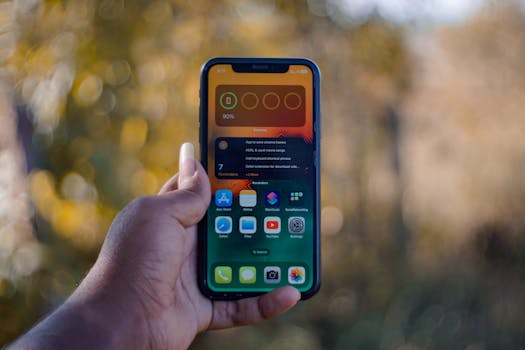
Close-up of a hand holding a smartphone outdoors in TN, India, showing apps on screen. Photo: Soundarapandian MS / Pexels
The display is your window to the smartphone experience, and both the iPhone 15 and Samsung Galaxy S24 offer stunning visual feasts. The iPhone 15 features a 6.1-inch Super Retina XDR OLED display. It boasts a resolution of 2556 x 1179 pixels, providing crisp text and vibrant colors. A significant upgrade for the standard iPhone 15 is the inclusion of the Dynamic Island, previously exclusive to the Pro models. This innovative pill-shaped cutout dynamically expands and contracts to show alerts, activities, and notifications, enhancing the user interface. The display offers impressive peak brightness for HDR content and excellent outdoor visibility, with typical brightness up to 1000 nits and peak HDR brightness up to 1600 nits. However, it retains a standard 60Hz refresh rate, which some might find less fluid compared to higher refresh rate displays. Apple's color accuracy and True Tone technology ensure a natural viewing experience tailored to ambient lighting. The ceramic shield front cover also provides superior drop resistance. In contrast, the Samsung Galaxy S24 sports a 6.2-inch Dynamic AMOLED 2X display, offering a slightly larger canvas. Its resolution is 2340 x 1080 pixels. A major advantage of the Galaxy S24 display is its adaptive refresh rate, ranging from 1Hz to 120Hz. This provides incredibly smooth scrolling and animations while also conserving battery life when a high refresh rate isn't needed. The display reaches an astonishing peak brightness of up to 2600 nits, making it incredibly legible even under direct sunlight and offering superior HDR performance. Samsung's displays are known for their vibrant, saturated colors, which pop off the screen. The bezels are also notably thinner than the iPhone 15, providing a more immersive edge-to-edge viewing experience. Both displays are fantastic, but the Galaxy S24's higher refresh rate and significantly brighter panel give it an edge for multimedia consumption and overall fluidity. Regarding battery life, both devices offer all-day usage for most users. The iPhone 15, with its efficient A16 Bionic chip and optimized iOS, typically provides excellent endurance, often lasting a full day of moderate to heavy use. Apple quotes up to 20 hours of video playback. The Galaxy S24, despite its larger, brighter, and higher refresh rate display, also delivers strong battery performance thanks to the efficient Snapdragon 8 Gen 3/Exynos 2400 and Samsung's software optimizations. Real-world usage shows both phones capable of getting through a typical day. Charging speeds are decent for both, with the iPhone 15 adopting USB-C for faster wired charging and MagSafe wireless charging, while the Galaxy S24 supports faster wired charging and Qi wireless charging. For more on maximizing your device's lifespan, explore our guide on smartphone battery health tips. Finally, the ecosystem plays a crucial role. Apple's iOS ecosystem is known for its seamless integration across devices (iPhone, iPad, Mac, Apple Watch), robust privacy features, and consistent user experience. If you already own other Apple products, the iPhone 15 slots in perfectly. Samsung's One UI on Android offers unparalleled customization, greater openness, and deep integration with Google services. Its 'DeX' feature allows you to connect your phone to an external display for a desktop-like experience, and its extensive app store offers more flexibility. The choice here is deeply personal and depends on your existing tech setup and preferred level of customization and control.

Galaxy AI vs. iOS Intelligence: Differentiating Features and User Experience
Close-up of a smartphone showing a chat app interface on a wooden table. Photo: Airam Dato-on / Pexels
The Samsung Galaxy S24 makes a significant leap forward with its suite of 'Galaxy AI' features, positioning artificial intelligence as a core differentiator. These AI functionalities are deeply integrated into the device's software and aim to enhance productivity, communication, and creativity. One of the standout features is 'Circle to Search with Google,' allowing users to simply circle any object on their screen to instantly perform a Google search for it – whether it's an item in a photo, text in an article, or a landmark in a video. This intuitive interaction streamlines information retrieval. Another powerful AI tool is 'Live Translate,' which provides real-time voice and text translation during phone calls, breaking down language barriers effortlessly. This feature runs on-device, ensuring privacy and speed. 'Chat Assist' can help refine message tones, from formal to casual, and even translate messages. For note-takers, 'Note Assist' can summarize lengthy notes, format them into templates, and even correct spelling and grammar. Photo editing receives a major boost with 'Generative Edit,' enabling users to resize, reposition, or even remove objects from photos, with the AI intelligently filling in the background. 'Transcript Assist' can convert voice recordings into text, summarize them, and even identify different speakers. These AI features are designed to be truly helpful, offering practical solutions to everyday challenges and showcasing the power of on-device AI processing. While the iPhone 15 doesn't brandish a dedicated 'iOS AI' suite in the same explicit way, Apple has been integrating artificial intelligence and machine learning into its operating system and applications for years, often in a more subtle, behind-the-scenes manner. Features like Siri, Face ID, computational photography (Photonic Engine, Deep Fusion, Smart HDR), and predictive text are all powered by advanced AI and ML. The A16 Bionic's neural engine is constantly working to improve app performance, optimize battery life, enhance security, and personalize the user experience. iOS also offers intelligent suggestions for apps, contacts, and events based on your usage patterns. Focus Modes use AI to understand when and how to deliver notifications. The Photos app uses machine learning for facial recognition, object detection, and creating curated memories. While not as overtly presented as Samsung's 'Galaxy AI,' Apple's approach ensures that AI enhances the core user experience without requiring explicit user interaction for many features. However, it currently lacks the generative AI capabilities seen in the Galaxy S24, such as real-time call translation or generative photo edits. The choice between these two approaches depends on whether you prefer explicit, groundbreaking AI tools for specific tasks (Samsung) or a more pervasive, integrated AI that subtly enhances the entire operating system (Apple) and its core functions. Another point of comparison is the long-term software support. Apple is renowned for providing many years of iOS updates to its devices, often exceeding five years. This ensures iPhones remain secure and receive new features for an extended period. Samsung has also significantly stepped up its game, now offering 7 years of OS updates and security patches for its flagship Galaxy S24 series, matching or even surpassing Apple's commitment. This long-term support is excellent news for consumers, guaranteeing that their premium investment will remain relevant and secure for many years, enhancing the overall value proposition of both devices.

Comparison

FeatureiPhone 15Samsung Galaxy S24Our Pick
ProcessorA16 BionicSnapdragon 8 Gen 3 for Galaxy / Exynos 2400Tie (both exceptional)
Display Size6.1-inch6.2-inchGalaxy S24 (slightly larger)
Refresh Rate60Hz1-120Hz AdaptiveGalaxy S24 (smoother)
Peak Brightness1600 nits (HDR)2600 nits (Peak)Galaxy S24 (brighter)
Main Camera48MP (24MP default)50MP (pixel binning)Tie (different processing)
Telephoto Lens2x Optical Quality (digital)10MP 3x OpticalGalaxy S24 (dedicated lens)
Video Recording4K 60fps, Cinematic Mode8K 30fps, 4K 120fpsGalaxy S24 (higher resolution)
Charging PortUSB-CUSB-CTie
AI FeaturesIntegrated iOS intelligenceGalaxy AI (Circle to Search, Live Translate, Generative Edit)Galaxy S24 (explicit, advanced AI)
Software EcosystemiOSAndroid (One UI)Depends on user preference
Software Updates5+ years7 yearsGalaxy S24 (longer commitment)
Starting Price (US)$799$799Tie

What Readers Say

"I chose the iPhone 15 for its seamless integration with my Mac and Apple Watch. The camera is fantastic for everyday photos, and iOS is just so intuitive. I haven't regretted my decision at all; it's a solid upgrade."

Sarah J. · Austin, TX

"The Galaxy S24's AI features are a game-changer for me. Live Translate during calls with international clients is a lifesaver, and 'Circle to Search' has become incredibly useful. The display is also unbelievably bright."

Mark D. · Seattle, WA

"After reading this comparison, I picked the S24 primarily for its 120Hz display and dedicated telephoto lens. My photos look amazing, and scrolling is buttery smooth. It's truly a premium experience that delivered on all its promises."

Jessica L. · Miami, FL

"I went with the iPhone 15 because I'm deep into the Apple ecosystem. While I sometimes wish for a higher refresh rate display, the overall performance and camera quality are excellent. It's a reliable and powerful phone, just not as flashy with new AI features."

David P. · Chicago, IL

"As a content creator, the 8K video recording on the Galaxy S24 was a huge selling point. Plus, the Generative Edit tools in the photo editor save me so much time. It's a creative powerhouse, easily outperforming my old phone."

Emily R. · Denver, CO

Frequently Asked Questions

Which phone has a better camera: iPhone 15 or Samsung Galaxy S24?

Both phones have excellent cameras, but their strengths differ. The iPhone 15 excels with natural color reproduction, consistent results, and exceptional video. The Galaxy S24 offers more vibrant, punchy colors, a dedicated 3x optical telephoto lens, 8K video, and advanced AI editing features. Your preference depends on whether you value natural realism and video (iPhone) or vibrant versatility and advanced zoom/AI editing (Samsung).

Is the iPhone 15 or Galaxy S24 faster for everyday use?

For everyday use, both the iPhone 15 (A16 Bionic) and the Galaxy S24 (Snapdragon 8 Gen 3/Exynos 2400) are incredibly fast and fluid. You won't notice significant lag or slowdowns with either device. The choice here is more about the fluidity of the 120Hz display on the S24 versus the 60Hz on the iPhone 15, which can make the S24 *feel* smoother, even if raw processing power is comparable.

How do Galaxy AI features compare to Apple's AI on the iPhone 15?

Galaxy AI on the S24 introduces explicit, groundbreaking features like 'Circle to Search,' 'Live Translate,' and 'Generative Edit,' offering direct and tangible AI-powered tools. Apple's AI on the iPhone 15 is more subtly integrated throughout iOS, powering features like Siri, Face ID, computational photography, and predictive text, enhancing the overall experience without explicit 'AI' branding. The S24's AI is more about new, innovative functionalities, while the iPhone's is about perfecting existing ones.

Is the iPhone 15 or Galaxy S24 a better value for the price?

Both the iPhone 15 and Galaxy S24 start at the same price point ($799 in the US), offering excellent value for flagship features. The Galaxy S24 offers a 120Hz adaptive display, a dedicated telephoto lens, 8K video, and advanced AI features at this price. The iPhone 15 offers the robust Apple ecosystem, consistent performance, and excellent video capabilities. The better value depends entirely on which set of features aligns more with your personal priorities and ecosystem preference.

Which phone has better battery life, the iPhone 15 or Galaxy S24?

Both the iPhone 15 and Samsung Galaxy S24 offer excellent all-day battery life for most users. Real-world tests show them performing very similarly under typical usage. While the S24 has a higher refresh rate and brighter screen, its efficient processor and adaptive refresh rate help manage power consumption effectively. You can expect reliable, full-day usage from either device.

Who should buy the iPhone 15, and who should buy the Galaxy S24?

You should buy the iPhone 15 if you're already in the Apple ecosystem, prioritize user-friendliness, consistent camera performance with natural colors, and exceptional video capabilities. Opt for the Galaxy S24 if you prefer Android's customization, desire a 120Hz display, want a dedicated telephoto lens, are excited by cutting-edge AI features, and appreciate vibrant photo processing.

Are there any major security differences between iPhone 15 and Galaxy S24?

Both Apple and Samsung prioritize security, offering robust features. iPhones are renowned for their strong privacy and security protocols, with end-to-end encryption and a tightly controlled app ecosystem. Samsung's Knox security platform on the Galaxy S24 provides multi-layered protection for data and hardware, and Android receives regular security updates. Both are highly secure devices, with slightly different architectural approaches to achieving that security.

What are the future trends for these two phone lines?

Future trends for both iPhone and Galaxy lines point towards continued advancements in AI, particularly on-device generative AI, improved camera sensors and computational photography, and further integration into their respective ecosystems. Expect even more efficient processors, longer battery life, and potentially more immersive display technologies. Apple might bring higher refresh rates to standard iPhones, while Samsung will likely expand its AI capabilities further.

Ready to make your choice? Use this comprehensive guide to compare iPhone 15 vs Samsung Galaxy S24 and confidently select the smartphone that perfectly fits your lifestyle and needs. Your ideal mobile experience awaits.

Topics: compare iphone 15 vs samsung galaxy s24iphone 15 featuresgalaxy s24 specsbest flagship phonesmartphone comparison
Leo List

DK Escorts LU Escorts AT Escorts SE Escorts FI Escorts CH Escorts DE Escorts HR Escorts IE Escorts GR Escorts CZ Escorts NO Escorts BE Escorts FR Escorts SI Escorts IL Escorts NL Escorts PL Escorts HU Escorts ES Escorts IT Escorts PT Escorts SK Escorts RO Escorts ZA Escorts UY Escorts US Escorts UK Escorts NZ Escorts AU Escorts
Brampton weed
Adultwork EstrelaBet Vai de Bet R7 Bet Betão Galera Bet Rainbet Bet9ja Shop SportyBet BetKing Sisal Loto Foot Hollywoodbets YesPlay Odibets RushBet Jugabet BetWarrior BetCity MSport betPawa Fortebet