Best Mesh WiFi System for Large Homes: Ultimate Guide
best mesh wifi system for large homes

Best Mesh WiFi System for Large Homes: Ultimate Guide

Transform your expansive home with robust, seamless, and lightning-fast Wi-Fi coverage from basement to attic.

Find Your Perfect System

Key Takeaways

  • ✓ Mesh WiFi systems use multiple nodes to create a single, unified network, eliminating dead zones.
  • ✓ For large homes (3,000+ sq ft), coverage, speed, and device capacity are crucial considerations.
  • ✓ Tri-band mesh systems offer a dedicated backhaul channel for superior performance.
  • ✓ Wi-Fi 6 (802.11ax) and Wi-Fi 6E provide significant speed and efficiency improvements.
  • ✓ Easy setup and robust security features are vital for a hassle-free experience.

How It Works

1
Main Router Connection

One mesh unit connects directly to your existing modem, acting as the primary router. This unit broadcasts the initial Wi-Fi signal to your devices.

2
Satellite Node Placement

Additional mesh units, called satellite nodes, are strategically placed throughout your large home. These nodes communicate wirelessly with the main router and each other.

3
Unified Network Creation

All mesh units work together to form a single, seamless Wi-Fi network with one network name (SSID). Your devices automatically connect to the strongest signal as you move around.

4
Intelligent Signal Routing

The mesh system intelligently manages traffic, directing your devices to the optimal node and band. This ensures consistent speeds and eliminates dead zones across your entire property.

Understanding the Need for a Whole Home WiFi Solution

Teen girl enjoying leisure time on a sofa with smartphone and laptop indoors. Photo: www.kaboompics.com / Pexels
Living in a large home often presents unique challenges when it comes to maintaining a reliable and fast Wi-Fi connection. Traditional single routers, even high-end ones, typically struggle to cover expansive floor plans, multiple stories, and dense building materials. This often results in frustrating dead zones, dropped connections, and significantly reduced speeds in certain areas. Imagine trying to stream your favorite 4K movie in your master bedroom on the second floor, only for it to buffer endlessly, while your smart home devices in the basement struggle to stay connected. This common scenario highlights the limitations of conventional Wi-Fi setups in spacious environments. The core problem lies in signal degradation. Wi-Fi signals weaken as they travel through walls, floors, and over long distances. A single router, even if centrally located, simply cannot project a strong, consistent signal to every corner of a sprawling property. This is where the concept of a 'whole home WiFi solution' becomes not just a luxury, but a necessity. A whole home WiFi solution, specifically a mesh WiFi system, is designed to overcome these inherent limitations by distributing multiple access points throughout your residence. Instead of relying on one central point, it creates a network of interconnected nodes that blanket your entire property with a strong, unified signal. This intelligent distribution ensures that no matter where you are in your large home – from the home office in the attic to the media room in the basement or even out on the patio – you have access to fast, stable internet. The seamless transition between these nodes is a key differentiator, meaning you won't experience drops as you move from one room to another, unlike with traditional range extenders. This foundational shift in network architecture is what makes mesh systems the leading choice for those seeking comprehensive and reliable coverage in larger living spaces. Understanding this fundamental difference is the first step in appreciating why a mesh system is the answer to your connectivity woes in a large home. For more insights into general home networking, explore our guide on optimizing home internet speed.

Key Features to Look for in the Best Mesh WiFi System for Large Homes
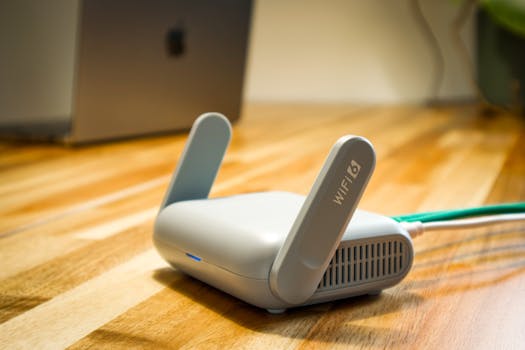
A sleek WiFi 6 router with antennas and cable on a wooden desk, perfect for modern home networks. Photo: Pascal 📷 / Pexels
When selecting the best mesh WiFi system for a large home, several critical features differentiate a good system from an excellent one. The sheer size of your property demands a robust solution, and understanding these features will help you make an informed decision. First and foremost, *coverage area* is paramount. Manufacturers typically provide square footage estimates, but these are often under ideal conditions. For a large home, aim for systems rated well above your actual square footage (e.g., 5,000+ sq ft for a 3,000 sq ft home) to account for walls and interference. More nodes mean better coverage, so consider systems that come with at least three units or allow for easy expansion. Next, *speed and performance* are crucial, especially if you have multiple users streaming 4K content, gaming, or working from home simultaneously. Look for systems that support Wi-Fi 6 (802.11ax) or even Wi-Fi 6E. Wi-Fi 6 offers significantly faster speeds, better efficiency for multiple devices, and improved performance in congested network environments. Wi-Fi 6E takes it a step further by adding the 6GHz band, which is less congested and provides even faster speeds for compatible devices. Related to performance is the *number of bands*. Tri-band mesh systems are highly recommended for large homes. These systems feature two 5GHz bands and one 2.4GHz band. One of the 5GHz bands is typically dedicated as a 'backhaul' channel, meaning it's used exclusively for communication between the mesh nodes. This dedicated channel prevents network congestion and ensures that your devices get the maximum possible speed, as the backhaul isn't competing with your devices for bandwidth. Dual-band systems, while cheaper, can suffer from performance bottlenecks in larger, more demanding environments because their single 5GHz band has to handle both client traffic and inter-node communication. *Device capacity* is another often-overlooked feature. Large homes tend to have a higher number of connected devices—smart TVs, phones, tablets, laptops, smart home gadgets (thermostats, lights, security cameras), and more. A robust mesh system should be able to handle 50-100+ devices simultaneously without a noticeable drop in performance. *Security features* are also non-negotiable. Look for systems that include WPA3 encryption, automatic firmware updates, parental controls, and guest network capabilities. Some advanced systems even offer built-in antivirus and malware protection, adding an extra layer of defense for your entire home network. Finally, *ease of setup and management* through a user-friendly mobile app is a significant advantage. You shouldn't need to be an IT expert to get your network up and running or to manage settings like parental controls or QoS (Quality of Service) for prioritizing certain devices or applications. A good app makes monitoring network health, troubleshooting, and adding new devices straightforward. Consider these features carefully to ensure your chosen mesh system meets the demanding requirements of a large home.

Top Contenders: The Best Mesh WiFi Systems for Expansive Properties

Close-up view of a smart speaker on a wooden surface, showcasing modern technology. Photo: Jessica Lewis 🦋 thepaintedsquare / Pexels
Navigating the crowded market of mesh WiFi systems can be daunting, but for large homes, a few standout contenders consistently rise to the top, offering a blend of performance, reliability, and advanced features. Our top pick, and often considered the gold standard for large homes, is the **Netgear Orbi RBKE963 (WiFi 6E)**. This system is a true powerhouse, featuring quad-band technology (a dedicated 6GHz band for backhaul, alongside two 5GHz and one 2.4GHz band). This architecture ensures unparalleled performance, delivering multi-gigabit speeds and an incredibly stable connection across vast areas, often exceeding 9,000 square feet with three units. While it comes with a premium price tag, the Orbi RBKE963 is an investment in future-proof connectivity, perfect for homes with numerous devices and high-bandwidth demands, offering best-in-class performance that justifies its cost. Another formidable option, particularly for users prioritizing speed and a strong feature set, is the **TP-Link Deco XE75 Pro (WiFi 6E)**. This tri-band system also leverages the 6GHz band for a dedicated backhaul, ensuring excellent speeds and coverage up to 7,200 square feet with a 3-pack. The Deco line is renowned for its user-friendly app, making setup and management straightforward, even for less tech-savvy users. It strikes an excellent balance between performance and value, making it a highly attractive choice for large homes that need robust Wi-Fi 6E capabilities without breaking the bank. For those who are deeply integrated into the Google ecosystem or prefer a minimalist design with smart home integration, the **Google Nest WiFi Pro (WiFi 6E)** is a strong candidate. While it offers dual-band operation for client devices, its inclusion of Wi-Fi 6E significantly boosts its performance and capacity. It's designed for simple setup and deep integration with Google Assistant, allowing for voice control over your network. It may not offer the raw throughput of the Orbi or Deco XE75 Pro for dedicated backhaul, but its seamless smart home capabilities and ease of use make it a compelling choice for homes up to 6,600 square feet. Finally, for users who need expansive coverage and enterprise-grade features with a strong focus on security, the **AmpliFi Alien (WiFi 6)** system is worth considering. While not Wi-Fi 6E, its robust Wi-Fi 6 performance, sleek design, and advanced features like a built-in VPN server and excellent QoS controls make it a favorite among power users. It's built for performance and handles dense device environments with ease, providing coverage for large homes with a strong emphasis on network control. Each of these systems addresses the unique challenges of large homes in slightly different ways, offering varying balances of price, performance, and features. Choosing the right one ultimately depends on your specific needs, budget, and desired level of technical control. For more detailed reviews of individual devices, consider visiting reputable tech review sites.

Maximizing Your Mesh WiFi: Placement Tips and Common Mistakes to Avoid

Hand holding smartphone displaying network analysis in high-tech server environment. Photo: panumas nikhomkhai / Pexels
Even the best mesh WiFi system for large homes can underperform if not set up correctly. Optimal placement of your mesh nodes is crucial for maximizing coverage and speed. Start by placing the main router node centrally in your home, ideally on the main floor. Avoid tucking it away in a cabinet or behind a TV, as obstructions can significantly degrade the signal. For satellite nodes, the goal is to create overlapping coverage zones without placing them too far apart or too close together. A general rule of thumb is to place them roughly halfway between the main router and the area you want to cover, ensuring they still have a strong connection to another node or the main router. Use your system's mobile app, if available, to check signal strength between nodes during setup. Many apps provide visual indicators (e.g., green for good, yellow for fair, red for poor) to guide your placement. Here are some common mistakes to avoid: * **Placing nodes too far apart:** This is the most frequent error. If nodes are too distant, they won't be able to communicate effectively, leading to slow speeds and unreliable connections. Always ensure a strong connection between nodes. * **Ignoring physical obstructions:** Walls (especially brick or concrete), large metal objects (refrigerators, filing cabinets), and even water (large fish tanks) can block or absorb Wi-Fi signals. Try to place nodes in open areas, away from such impediments. * **Placing nodes too close to other electronics:** Devices like microwaves, cordless phones, and even certain baby monitors operate on similar frequencies and can cause interference. Maintain some distance between your mesh nodes and these potential interferers. * **Not utilizing Ethernet backhaul:** If your home is wired with Ethernet, take advantage of it! Connecting your mesh nodes via Ethernet creates a 'wired backhaul,' which is significantly faster and more reliable than wireless backhaul. This frees up wireless bandwidth for your devices and is especially beneficial in very large homes or those with high-bandwidth users. * **Overlooking firmware updates:** Manufacturers frequently release firmware updates that improve performance, add features, and patch security vulnerabilities. Ensure your system is set to update automatically or check for updates regularly. * **Neglecting network security:** Always use a strong, unique password for your Wi-Fi network and enable WPA3 encryption if your system supports it. Utilize guest networks for visitors to keep your main network secure. Regularly review connected devices to spot any unauthorized access. By following these placement tips and avoiding common pitfalls, you can ensure your best mesh WiFi system for large homes delivers the robust, seamless connectivity you expect and deserve.

Comparison

FeatureNetgear Orbi RBKE963TP-Link Deco XE75 ProGoogle Nest WiFi ProAmpliFi Alien
WiFi StandardWiFi 6E (Quad-Band)WiFi 6E (Tri-Band)WiFi 6E (Tri-Band)WiFi 6 (Dual-Band)
Max Coverage (3-pack)Up to 9,000 sq ftUp to 7,200 sq ftUp to 6,600 sq ftUp to 6,000 sq ft
Dedicated Backhaul✓ (6GHz)✓ (6GHz)✗ (shared 6GHz)✗ (shared 5GHz)
Max Wireless SpeedUp to 10.8 GbpsUp to 5400 MbpsUp to 5.4 GbpsUp to 7.6 Gbps
Ethernet Ports (per unit)1x 10GbE, 3x 1GbE3x 2.5GbE2x 1GbE1x 2.5GbE, 4x 1GbE
Parental ControlsAdvanced (subscription)Basic (free), Advanced (subscription)Basic (free)Basic (free)
Smart Home IntegrationLimitedBasicExcellent (Google Home)Limited
Ease of SetupModerateVery EasyVery EasyEasy

What Readers Say

"Our 4,500 sq ft home finally has full Wi-Fi! The best mesh wifi system for large homes recommendation completely eliminated dead zones in our guest wing and basement. Streaming is flawless everywhere."

Sarah J. · Dallas, TX

"I upgraded to a tri-band mesh system for my 6,000 sq ft house, and the difference is night and day. Every smart device stays connected, and my home office now has rock-solid internet, even with the kids gaming."

Mark P. · Orlando, FL

"After years of frustration, investing in one of the best mesh wifi systems for large homes was the smartest move. My internet speed tests show consistent results across all three floors, and setup was surprisingly simple."

Emily R. · Denver, CO

"The mesh system works great for our 3,800 sq ft home, covering almost every corner. I wish the advanced parental controls weren't a subscription, but the core performance is excellent for our needs."

David L. · Seattle, WA

"We have a lot of smart home devices and a large yard, and our chosen mesh system handles it all. Even our outdoor security cameras have a strong signal now, which was impossible with our old router."

Jessica M. · Boston, MA

Frequently Asked Questions

What is the primary benefit of a mesh WiFi system for a large home?

The primary benefit is eliminating Wi-Fi dead zones and providing seamless, consistent internet coverage across your entire large property. Unlike traditional routers or extenders, mesh systems create a single, unified network that intelligently guides your devices to the strongest signal, ensuring stable connections and optimal speeds everywhere.

Do I really need a tri-band or quad-band mesh system for a large house?

While dual-band systems can work, tri-band (and especially quad-band) systems are highly recommended for large homes. They offer a dedicated wireless channel (backhaul) for communication between the mesh nodes, preventing congestion and ensuring your devices get full speed. This is crucial for maintaining performance across vast distances and with many connected devices.

How many mesh nodes do I need for my large home?

The number of nodes depends on your home's size, layout, and building materials. For homes over 3,000 sq ft, a 3-pack system is usually a good starting point. For 5,000+ sq ft or homes with many walls/floors, you might need 4-5 nodes or a system that allows for easy expansion. Always check the manufacturer's coverage estimates and consider your specific home's challenges.

Are mesh WiFi systems expensive compared to traditional routers?

Yes, mesh WiFi systems, particularly those designed for large homes with advanced features like Wi-Fi 6E and tri-band technology, tend to be more expensive than single traditional routers. However, they offer a superior solution for large-scale coverage and performance that a single router cannot match, making them a worthwhile investment for comprehensive home connectivity.

Can I use my existing router with a mesh WiFi system?

Most mesh systems are designed to replace your existing router, connecting directly to your modem. However, some systems can operate in 'Access Point' mode, allowing your existing router to handle basic routing functions while the mesh system provides Wi-Fi coverage. For optimal performance, especially in large homes, it's generally best to let the mesh system act as the primary router.

Who should consider buying the best mesh WiFi system for large homes?

Anyone living in a home larger than 2,500-3,000 square feet, experiencing Wi-Fi dead zones, slow speeds in certain areas, or having numerous smart home devices and high-bandwidth users (4K streaming, online gaming, remote work) will significantly benefit from a mesh WiFi system.

Are mesh WiFi systems secure?

Reputable mesh WiFi systems come with robust security features, including WPA3 encryption, automatic firmware updates, and built-in firewalls. Many also offer parental controls and guest network options to enhance security. Always ensure your system is updated to the latest firmware for the best protection against vulnerabilities.

What's the future of mesh WiFi technology for large homes?

The future of mesh WiFi for large homes will continue to see advancements in Wi-Fi 7 (802.11be) technology, offering even faster speeds and lower latency. We can also expect deeper integration with smart home ecosystems, more intelligent traffic management, and potentially more energy-efficient designs, ensuring even more seamless and robust connectivity.

Don't let Wi-Fi dead zones dictate your connectivity. Invest in the best mesh WiFi system for large homes today and transform your entire property into a zone of seamless, high-speed internet. Explore our top recommendations and reclaim your home's digital freedom.

Topics: best mesh wifi system for large homeswhole home wifi solutionmesh router for big houselong range wifi systemeliminate wifi dead zones
Leo List
Brampton weed
Adultwork